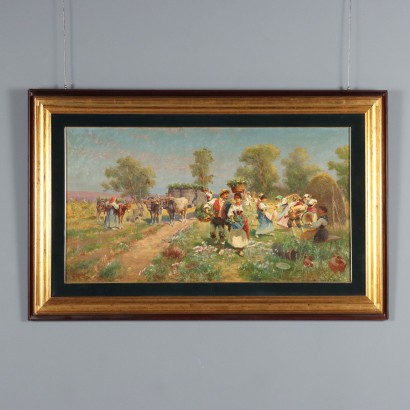
Antique Painting Signed Giuseppe Canella Lecco Pier 1837 - Lecco Imbarcadero 1837


Lecco Imbarcadero 1837
Code: ARAROT0327301

from 333.33 €/month for 15 months without interest Find out more
Curbside shipping cost for the item throughout Italy (excluding the islands).


Features
Lecco Imbarcadero 1837
Artist: Giuseppe Canella (1788-1847) Attributed to
Artwork title: Lecco, Imbarcadero
Age: 19th Century / 1801 - 1900
Subject: Landscape with Figures
Origin: Italy
Artistic technique: Painting
Technical specification: Oil on Canvas
Description : Lecco, Imbarcadero
Oil on canvas. Signature, date, and title at the bottom left. Giuseppe Canella was one of the most important Veronese landscape and view painters of the 19th century. He made numerous trips throughout Europe, bringing back glimpses and views of European cities, which allowed him to study Flemish painting in particular. In 1835, he returned to Italy, dedicating himself to Italian landscape painting, especially of Lombard cities, which, under Flemish influence, were characterized by a clear departure from rigid classical vedutism and by the choice of particular lighting and color effects. The painting presented here, although signed and consistent with Canella's work in subject matter and pictorial style, is stylistically less effective in execution, thus casting doubt on its definitive attribution to the artist; nevertheless, it remains a work of considerable quality. The painting is presented in a period frame.
Product Condition:
The item is in good condition, with minor signs of wear. We try to present the item's actual condition as accurately as possible with the photos. If any details are unclear from the photos, the description will apply.
Frame Size (cm):
Height: 92
Width: 117
Depth: 5
Artwork dimensions (cm):
Height: 75
Width: 100
Additional Information
Artist: Giuseppe Canella (1788-1847)
Born in Verona in 1788, Giuseppe Canella received his first artistic training from his father Giovanni, an architect, fresco painter, and set designer; otherwise, Giuseppe Canella is considered self-taught. In his early years, he dedicated himself to creating sets for theaters in Verona and to the pictorial decoration, with frescoes, of noble residences in Verona and Mantua. Perhaps influenced by Pietro Ronzoni, an internationally renowned landscape painter active in Verona, he turned to landscape painting. After a stay in Mantua from 1811 to 1815, a brief stay in Venice allowed him to study the 18th-century Venetian and Venetian vedutisti. He also traveled to the Netherlands, discovering 17th-century Dutch landscape painters. Canella made his debut at the Brera Fine Arts Exhibition in 1818, exhibiting canvases with vedute. He then embarked on a long study trip that took him to Spain and France, and he stayed in Paris for ten years. Around 1830, he produced drawings depicting boulevards and views of the Seine in the historic center of Paris, which are visible in the collection of drawings at the Sforza Museum and are owned by the Galleria d'Arte Moderna in Milan. In France, he achieved fame for his constant presence at the Paris Salons; Louis-Philippe d'Orléans awarded him a gold medal in 1830. In 1832, Canella returned to Milan, where Ferdinand I of Austria had chosen him as a member of the Brera Academy. He devoted himself to creating city views, characterized by an interest in contemporary life. From 1835, he returned primarily to landscapes, choosing glimpses of the Lombard countryside and lakeside settings, but he also took an interest in poorer and more humble aspects, in line with the moralizing demands of Manzoni's work. Between 1838 and 1839, he made a study trip to Rome and Naples. Canella died in Florence in 1847.Age: 19th Century / 1801 - 1900
19th Century / 1801 - 1900Subject: Landscape with Figures
Artistic technique : Painting
La pittura è l'arte che consiste nell'applicare dei pigmenti a un supporto come la carta, la tela, la seta, la ceramica, il legno, il vetro o un muro. Essendo i pigmenti essenzialmente solidi, è necessario utilizzare un legante, che li porti a uno stadio liquido, più fluido o più denso, e un collante, che permetta l'adesione duratura al supporto. Chi dipinge è detto pittore o pittrice. Il risultato è un'immagine che, a seconda delle intenzioni dell'autore, esprime la sua percezione del mondo o una libera associazione di forme o un qualsiasi altro significato, a seconda della sua creatività, del suo gusto estetico e di quello della società di cui fa parte.Technical specification : Oil on Canvas
The oil painting is a painting technique using powder pigments mixed with bases in inert and oils.Other customers have searched:
Se sei un appassionato d'arte, non perderti i nostri approfondimenti sul Blog Arte Di Mano in Mano e su FineArt by Di Mano in Mano - Arte:
Leggi di più
Ecco alcuni tra i principali articoli:Vedute
Falsi nell'arte antica
Un messaggio di fiducia per ripartire
La potenza espressiva dell'arte figurativa etiope
Breve Storia del Collezionismo
Giorgio Upiglio, maestro dei libri d'artista
Matthias Withoos detto "Calzetta bianca"
San Rocco pensaci tu - Classic Monday
Dai un'occhiata alle nostre rubriche di divulgazione sull'arte:
Epoche
Lavorazioni e tecniche
Mostre ed Eventi
Protagonisti
Ti suggeriamo di guardare anche le presentazioni di questi dipinti ottocenteschi:
Tavoletta Porcellana Regina Luisa di Prussia, Berlino, Ultimo Quarto XIX secolo
Veduta di Frascati, Achille Etna Michallon, ambito di, terzo decennio XIX secolo, olio su tela
Venere Dormiente, Claudio Rinaldi, 1899
Sapevi che l'arte può essere anche un ottimo investimento (e non solo per grandi portafogli)?
L'Arte tra Collezionismo e Investimento
FineArt: Arte come investimento
Product availability
The product can be seen at Cambiago
Immediate availability
Ready for delivery within 2 working days from ordering the product.
Lecco Imbarcadero 1837
Code: ARAROT0327301
from 333.33 €/month for 15 months without interest Find out more
Curbside shipping cost for the item throughout Italy (excluding the islands).





Information
Offers & PromotionsWithdrawal Form
Terms and Conditions
Privacy Policy
Cookie Policy
Update your Cookie Policy Preferences
Who we are
ContactsOur History
Di Mano in Mano Team
Our shops
Why choose Di Mano in Mano
Eviction Service
Shop Information
Di Mano in Mano Soc. Coop.
Register of Cooperative Companies at No. A114664
Contact us Now
Registered Office:
info@dimanoinmano.it
VAT Number: IT12896370157
Believe in Us
General Conditions of Use and Sale. Online dispute resolution according to Art. 14 (1) Regulation on consumer ODR.
European Commission provides a platform for online dispute resolutions (ODR) which can be accessed under: https://ec.europa.eu/consumers/odr/
We Ship With: