Price

180 € 11600 € Apply

dimensioni opera


10 cm 175 cm

8 cm 238 cm

0 cm 11 cm

9 cm 10 cm
Apply

19th CENTURY PAINTINGS

- Page 3

Sort by
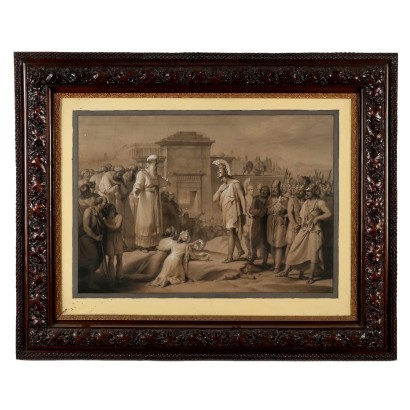
Antique Painting Alexander the Great in Gerusalem Mixed Technique
ARAROT0248042

Antique Painting Alexander the Great in Gerusalem Mixed Technique

ARAROT0248042
Antique Painting Alexander the Great in Gerusalem Mixed Technique

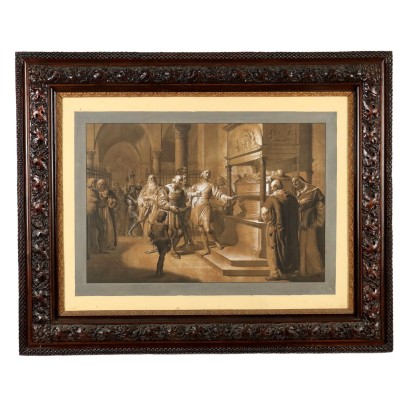
Mixed technique (pencil, pen, brown ink and white chalk) on paper. Italian school of the early 19th century. The scene represents the meeting between a high priest and a leader: if he is followed by his entire army, with grim and armed soldiers of different ranks, the priest is followed by all the people who praise the winner, while two young women on their knees they offer wreaths of flowers. Behind the scene, the mighty walls with the entrance door to a city, towards which the priest points, almost as if handing it over to the leader. The priest's clothing, in particular the presence of the so-called "Decision" breastplate that he wears, refers to an Israelite priest, and therefore the city could be Jerusalem; instead the clothing of the victorious leader, with the helmet surmounted by two horses, refers to Alexander the Great, who actually conquered the city in 332 BC. The drawing is presented in a carved wooden frame from the late 19th century.

In Cart

2,800.00€

In Cart
Antique Painting Ludovico il Moro Mixed Technique XIX Century
ARAROT0247129

Antique Painting Ludovico il Moro Mixed Technique XIX Century

Ludovico il Moro's farewell to his wife..

ARAROT0247129
Antique Painting Ludovico il Moro Mixed Technique XIX Century

Ludovico il Moro's farewell to his wife..

Mixed media (pencil, pen, brown ink and white chalk) on paper. Italian school of the early 19th century. Ludovico Maria Sforza cries at the tomb of his young wife Beatrice d'Este (1475 -1497); around him the friars of Santa Maria delle Grazie and on his left Bramante and Leonardo. On the short side of the marble canopy of the tomb there is the Sforza coat of arms, with two snakes and two eagles. Il Moro was profoundly shaken by the early death in childbirth of his very young wife Beatrice, his companion in his private but also political life, as well as his husband's, a patron of the artistic geniuses of their court, such as Leonardo da Vinci. and Bramante, authors of many pictorial and architectural works of the Visconti-Sforza court. Various versions of this episode are known, especially from the nineteenth century, from that of 1815 by Giovanni Battista Cigola at the Pinacoteca Ambrosiana, to that of Alessandro Reati of around 1850. The painting is presented in a carved wooden frame from the late 19th century.

In Cart

2,800.00€

In Cart
Antique Painting H. Clifford Warren Watercolour and Pencil 1878
ARAROT0234107

Antique Painting H. Clifford Warren Watercolour and Pencil 1878

Landscape with River and Figures 1878

ARAROT0234107
Antique Painting H. Clifford Warren Watercolour and Pencil 1878

Landscape with River and Figures 1878

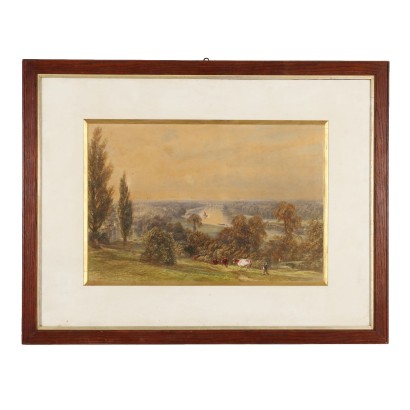
Watercolor and pencil on paper. Signed and dated lower left. We know of several landscape views of the English countryside by the English painter Henry Clifford Warren, mostly painted in watercolour. Here is a view of a wooded countryside crossed by a wide river, with a shepherd leading his cows to graze on the hill in the foreground. Presented in a frame.

In Cart

280.00€

400.00€

-30%
In Cart
Antique Painting Genre Scene Oil on Canvas French School '800
ARAROT0233383

Antique Painting Genre Scene Oil on Canvas French School '800

The Announcement of Defeat at Waterloo

ARAROT0233383
Antique Painting Genre Scene Oil on Canvas French School '800

The Announcement of Defeat at Waterloo

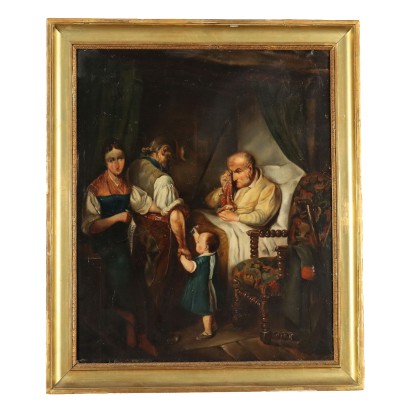
Oil painting on canvas. French school of the 19th century. The scene, set in the poor bedroom of an elderly war veteran, who is crying in his bed, sees his family telling him the sad news of the defeat at Waterloo, as can be deduced from the sheet of newspaper in the woman's hands, on which the name of the historic location where Napoleon Bonaparte was definitively defeated. The canvas shows signs of previous restorations, in particular the patch corresponding to the female figure is clearly visible. It is presented in an early 20th century setting.

In Cart

750.00€

In Cart
video
Antique Painting Historical Subject Oil on Canvas Italy XIX Century
ARAROT0132005

Antique Painting Historical Subject Oil on Canvas Italy XIX Century

ARAROT0132005
Antique Painting Historical Subject Oil on Canvas Italy XIX Century

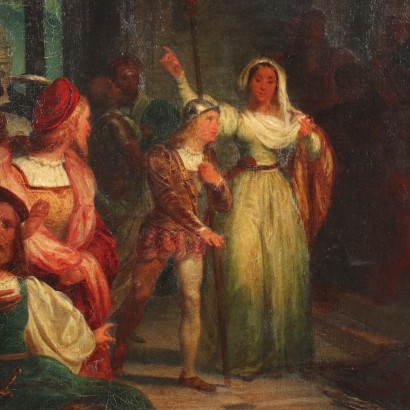
Oil on canvas. Mid 19th century. The large scene tells an unidentified historical episode, set in the Renaissance period, in which an archbishop listens to the plea of a young man in arms, accompanied by his mother, who supports his plea. The setting is inside the reception hall of the high prelate, presumably in the bishop's palace, which from the loggia in the background overlooks the Cathedral, whose dome can be glimpsed; the bishop is surrounded by his subordinates and guards, while different people of the people attend. Particular is the presence of the man sitting in the foreground on the left, who looks towards the viewer and points to the scene, as if he were telling it. The atmosphere is played on the contrasts between lights and shadows, between the bright colors of the dominant characters compared to the dull and suffused tones of the surrounding figures, who literally tend to disappear into the shadows at the limits of the scene. The work is part of that large nineteenth-century production that drew on the historical or literary subject, re-proposing it in a romantic key. The painting, restored and relined, is presented in an important frame from the second half of the 19th century, with some shortcomings.

In Cart

5,150.00€

In Cart
Antique Painting with Winter Landscape Oil on Canvas XIX Century
ARAROT0229486

Antique Painting with Winter Landscape Oil on Canvas XIX Century

ARAROT0229486
Antique Painting with Winter Landscape Oil on Canvas XIX Century

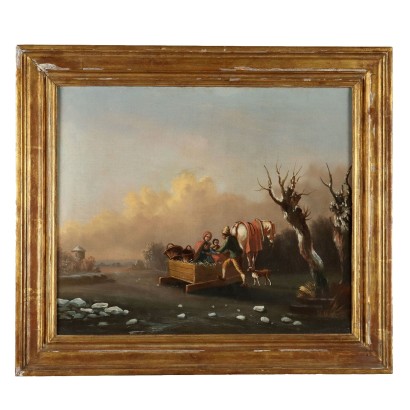
Oil painting on canvas. Northern European school of the early 19th century. The painting, according to nineteenth-century taste, aims to propose more of a genre scene than a landscape: in the foreground, in a barren countryside landscape with traces of snow, the figures of a small family descending from a sort of sleigh stand out. made of wood, filled with straw and pulled by a horse. Restored and relined, the painting is presented in a gilded wooden frame in style, with several defects.

Reserved

400.00€

800.00€

-50%
Reserved
Giovanni Boni Oil On Canvas 19th Century
ARAROT0116058

Giovanni Boni Oil On Canvas 19th Century

Siege Scene

ARAROT0116058
Giovanni Boni Oil On Canvas 19th Century

Siege Scene

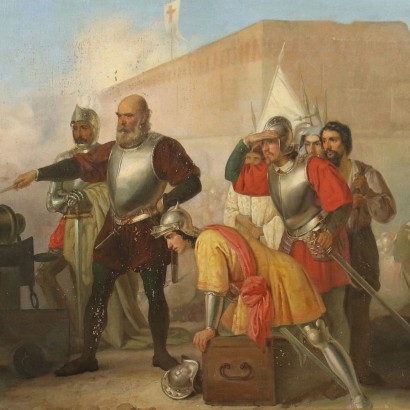
Oil on canvas. Outside the fortifications of a city, a commander, surrounded by his soldiers, is about to light the fuse of the cannon. The army defends the citadel outside the walls and the soldiers scan the horizon looking downwards: this leads us to place the scene on the fortifications of a city, in particular those of Genoa, that rise on the mountains behind it and from which the Genoese defended the city from attacks from the sea; the Genoa setting is also supported by the banner that flies over the walls, the Saint George Cross (red cross on a white background), flag of the Republic of Genoa. The shape of the armor, weapons and clothing would refer to the siege of Genoa in 1522. It is therefore the nineteenth-century representation of a historical episode, which is then part of that pictorial production widespread in Italy in the nineteenth century, inspired by the new historical novel popular in literature. On the back of the frame there is the name G. Boni, together with a number that refers to participation in an official exhibition. Giovanni Boni was a pupil of the Brera Academy, in particular a follower of Giuseppe Sogni, an artist who was among the first to favour historical painting in its innovative romantic declinations. Not much is known about Boni, neither from a biographical point of view nor from his production. Of his certain attribution we know only the Nude of Man (painted Academy) with which he won the first prize for the Scuola del Nudo in Brera in 1852. The piece expresses the figures and the pathos of the scene with expressive efficiency; the characters in the foreground are very well characterized in their poses, expressions, in the details of the clothes and weapons, while the other figures fade into the background, suggesting the presence of a large army. The painting, still on the first canvas, shows small widespread losses of colour. It is presented in a frame in style.

In Cart

2,340.00€

In Cart
The Tragic Return Oil on Canvas Late 1800s
ARTOTT0000724

The Tragic Return Oil on Canvas Late 1800s

ARTOTT0000724
The Tragic Return Oil on Canvas Late 1800s

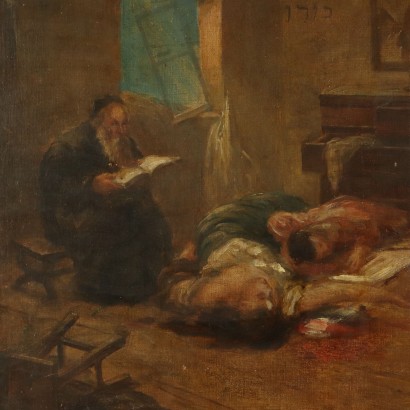
Oil on canvas. It probably depicts a tragic anti-Semitic event. On the right, a wounded soldier in Russian uniform is witnessing the dramatic scene of a slaughtered family while the rabbi is preying for them. The broken window and the upside down drawers make clear that the killers broke into the house. On the left of the mirror, there is a Jewish writing that may suggest the location. The word may be translated as 'Ciro' and may be referring to the areas of Georgia and Azerbaijan near the Kura (river flowing from Turkey to the Caspian Sea, known as 'Ciro' in 1800s). The painting, restored and relined, is presented in a frame of the 1800s.

In Cart

618.00€

1,235.00€

-50%
In Cart
Ancient Painting G. Sottocornola '800 Interior of a Stable Canvas
ARAROT0214056

Ancient Painting G. Sottocornola '800 Interior of a Stable Canvas

Stable interior

ARAROT0214056
Ancient Painting G. Sottocornola '800 Interior of a Stable Canvas

Stable interior

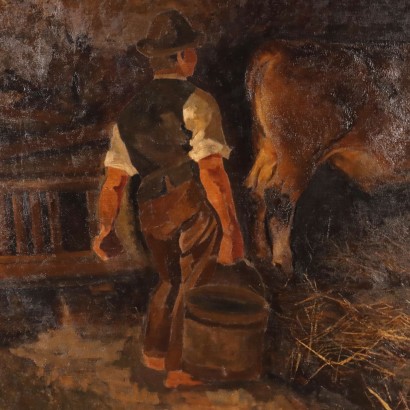
Oil painting on canvas. Signed lower left. The work was previously acquired at the Sotheby's auction in Milan on 10/12/2007. It was exhibited in 1991 in the exhibition "Giovanni Sottocornola. Images from a collection" held in Milan at the Silbernagl Gallery. After an initial pictorial phase dedicated to portraits and still lifes, in the 1880s Giovanni Sottocornola approached social themes, which were becoming the favorite subjects of young Lombard painters attentive to the poorest aspects of society, linked to the adoption of original artistic techniques. Sottocornola embraced the practice of pointillist painting, of which he wrote in 1895 "For now it is certain, I am convinced that there is no other painting more capable of conveying certain sensations than this one". However, this type of painting remained entirely focused on light, on its uncertain tonal vibrations, as happens in the Interior of a stable, created towards the end of the 1980s, where the plays of light and shadow play and create the effects visual in the brushstrokes of color played on a few chromatic ranges, those of browns, expressed in a wide variety of shades. The work is presented in a period frame.

In Cart

2,900.00€

In Cart
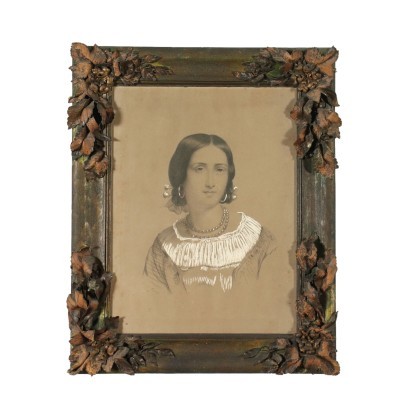
Portrait Of A Young Woman Pencil Charcoal Withe Lead On Paper 1858
ARAROT0118961

Portrait Of A Young Woman Pencil Charcoal Withe Lead On Paper 1858

ARAROT0118961
Portrait Of A Young Woman Pencil Charcoal Withe Lead On Paper 1858

Pencil, charcoal and white lead on paper. Signed (Amalia Bianchi?) and dated at the bottom right. Very effective is the use of different pigments that creates a play of chiaroscuri that underlines the figure. The portrait come in a 19th century wooden frame with leather leafy and floral inserts; it has missing parts and color drops.

In Cart

580.00€

In Cart
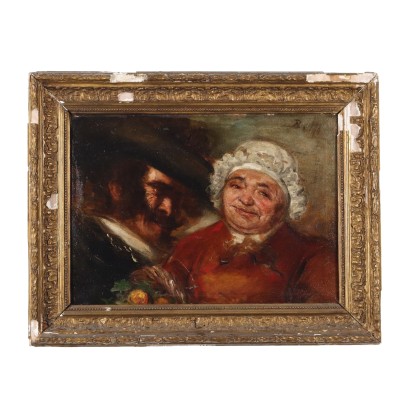
Oil on Canvas Satyrical Portrait France XIX Century
ARAROT0153051

Oil on Canvas Satyrical Portrait France XIX Century

ARAROT0153051
Oil on Canvas Satyrical Portrait France XIX Century

Oil on canvas. French school of the late 19th century. Trace of unidentified signature at the top right. In the foreground, the faces of two popular characters who seem caricatured, perhaps characters in a theatrical performance: it seems the scene of a satirical courtship, with the man who looks lasciviously at the woman, certainly not young and attractive, who is holding a bunch of flowers with an expression between resigned and confused. The painting is presented in a frame from the early 1900s.

In Cart

390.00€

780.00€

-50%
In Cart